

Short answer
- To find out how much steel a painted part has left, the usual options are removing the paint at every point or accepting an error: the paint adds to the reading, and by more than its own thickness.
- Echo-echo mode solves both: it measures the metal through the paint and the coating thickness cancels out of the calculation.
- It has clear limits: 2.5 to 25 mm of metal, a well-bonded coating up to 2 mm and a specific transducer.
It is the only version in the QS line with echo-echo mode. It measures 2.5 to 25 mm of metal under coatings up to 2 mm, and on unpainted parts it works as a standard thickness gauge, from 0.6 to 500 mm.
Problem 1: stripping paint at every measuring point
The symptom: a thickness survey on painted pipework, tanks or structures turns into grinding, measuring and repainting, point by point.
Why it happens: a standard thickness gauge (pulse-echo) measures the time from the pulse leaving to the back-wall echo. If there is paint, that time includes the trip through it, so to measure only the steel you have to reach bare metal.
What it costs:
| At each point | Strip and measure | Measure in echo-echo |
|---|---|---|
| Preparation | Grind or strip to bare metal | None |
| After measuring | Clean and repaint | Nothing to repair |
| Part protection | Point unprotected until repainted | Coating intact |
| Zero calibration | Required | Not required |
How it is solved: with echo-echo mode, which measures over the paint. In a survey with dozens or hundreds of points, the difference is counted in working days and square metres of paint.

Problem 2: measuring over the paint reads high
The symptom: to avoid stripping, you measure in standard mode over the paint… and the wall looks thicker than it is.
Why it happens: the gauge calculates with the steel velocity (around 5,920 m/s), but paint carries sound much more slowly, in the range of plastics (2,300–2,700 m/s according to the velocity chart). The time the pulse spends in the paint turns into extra "steel", more than twice the layer's thickness:
| Paint | Added to the reading |
|---|---|
| 0.3 mm | about +0.7 mm |
| 0.5 mm | about +1.1 to 1.2 mm |
| 1.0 mm | about +2.2 to 2.5 mm |
On a 6 mm wall, half a millimetre of paint can make a corroded pipe look sound. Indicative values: they depend on each paint's actual velocity.
How it is solved: the sound doesn't stop at the first echo: it bounces several times inside the metal and produces a series of successive back-wall echoes. Echo-echo mode measures the time between two of those echoes. As both have gone through the same paint, that part cancels out and only the trip through the metal remains. For the same reason, the transducer delay doesn't count either, and no zero calibration is needed.

Problem 3: thick or sound-absorbing coatings
The symptom: on marine epoxies or thick layers, the second echo arrives very weak and the reading is unstable.
Why it happens: each coating attenuates sound differently, and echo-echo needs the second echo to be strong enough.
How it is solved: with a transducer that gives clean, well-separated echoes (Hi-Damp) and by setting the gauge for the coating type. The practical limit is around 2 mm of coating, less if it strongly attenuates.
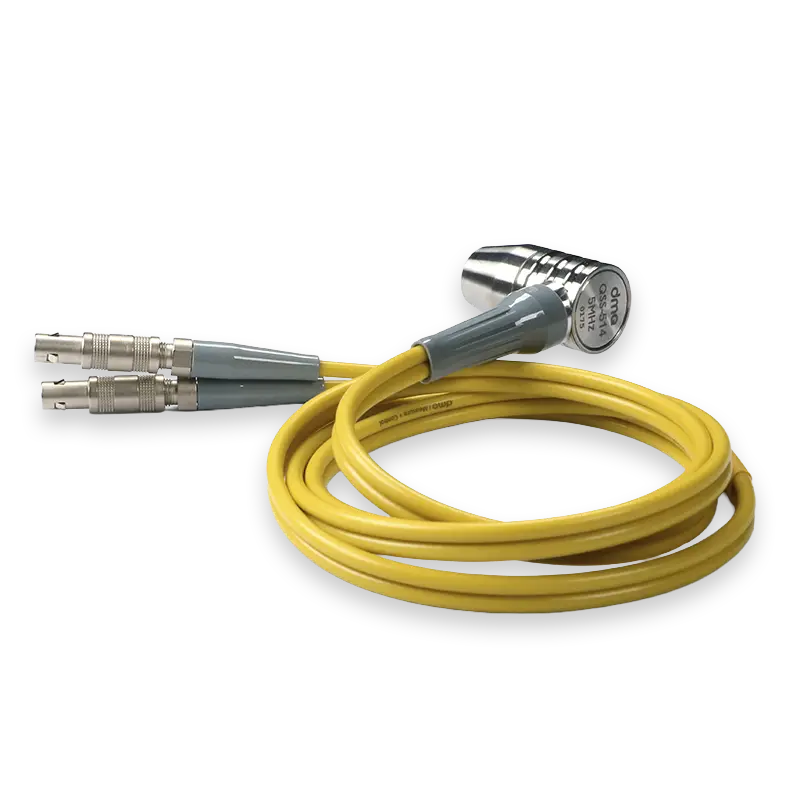
With the QS5 DLE: the "coating type" setting has two options: low loss for coatings under 1 mm and high loss for layers over 1 mm of highly attenuating materials, such as marine epoxies. It is used with dmq Hi-Damp transducers.
Problem 4: when echo-echo can't measure
- Peeling or blistered paint: if the coating isn't well bonded, ultrasound can't reach the metal. Measure on a sound spot or prepare the area.
- Wall over 25 mm: outside the echo-echo range. Measure in pulse-echo on a prepared spot.
- Wall under 2.5 mm: also out of range; the echoes arrive too close together.
- You need to know how much paint there is: echo-echo discards the paint, it doesn't measure it. That's a different instrument: see measuring the paint or measuring the wall.
How to measure in echo-echo with the QS5 DLE
- Connect a Hi-Damp transducer. Standard ones don't work properly in echo-echo.
- Set the metal velocity, as in a standard measurement. The paint's velocity doesn't matter: it cancels out.
- Switch to echo-echo with the echo key: the gauge toggles between Echo-1 (uncoated) and Echo-2 (coated) and shows which is active on every screen. Each mode keeps its own gain and settings.
- Choose the coating type: low or high loss.
- Apply enough couplant and measure over the paint.
Two details that can mislead: in echo-echo the energy bar looks low, because it shows the second echo, which is always weaker; that's normal. And on small parts, don't set the pulse voltage too high: as a guide, up to 150 V with 5 MHz transducers.
Source: DEMEQ, QS5 user manual (measuring coated parts, E and DLE versions) and QSS514 Hi-Damp transducer specifications.