

Short answer
- Measuring the wall of a bottle, jar, drum or plastic part looks easy, but runs into six problems: thin walls, curved shapes, gel, materials that absorb sound, the need to measure many parts quickly and soft rubber.
- Ultrasound struggles with almost all of them. The Hall effect solves them: it measures with no gel, from 0 mm, follows any shape and doesn't depend on how sound travels through the material.
- All it needs is to be able to place a small ball on the other side of the wall.
Bottles, jars, ampoules, drums, cans, rubber, airbags, laminates and composites, from 0 to 22 mm of wall. It is the most versatile instrument in our catalogue for non-ferrous materials.
The method, in one sentence
A small steel ball is placed on the other side of the wall; the probe magnet attracts it and holds it against the part, and a Hall sensor measures how far away it is. That distance is the thickness. As you slide the probe, the ball follows it on the inside and the reading updates as you go.

Problem 1: ultrasound can't read thin walls
The symptom: on a PET bottle or a thin jar, the ultrasonic gauge gives no reading, or one that isn't believable.
Why it happens: on a very thin wall, the echo from the inner face comes back almost as the pulse leaves, and the gauge can't separate them.
How it is solved: with a method that doesn't rely on echo timing. The Hall effect measures a magnetic distance, which is as clear at 0.2 mm as at 10 mm.
With the QB7: it measures from 0 mm, with 1 µm resolution up to 3 mm of wall.
Problem 2: necks, bottoms and corners
The symptom: on a bottle neck, a drum bottom or the radius of a moulded part, the transducer doesn't sit and the reading jumps.
Why it happens: ultrasound needs a flat, well-coupled face; on tight curves, the sound scatters.
How it is solved: by letting the part itself guide the measurement. With the Hall effect, the ball settles on its own inside, at the exact point being measured, whatever the shape.
With the QB7: as well as the standard tip, it has a narrow titanium tip to reach grooves and irregular shapes.
Problem 3: the part must not get wet or marked
The symptom: food, cosmetic or pharmaceutical containers that have to be cleaned after measuring, or are simply thrown away.
Why it happens: ultrasound needs gel or water between the transducer and the part for the sound to pass.
How it is solved: with a couplant-free method. The Hall effect measures dry: the part leaves as it came in, ready to go back on the line or into stock.
Problem 4: a different setting for each material, or no signal at all
The symptom: every change of plastic means looking up and setting another sound velocity; and on rubber, foams, fibre or laminates, ultrasound simply loses the signal.
Why it happens: ultrasound calculates thickness with each material's sound velocity (see the velocity chart), and soft or composite materials damp the sound before it returns.
How it is solved: with a method that doesn't depend on the material's acoustic properties. The Hall effect doesn't care whether the wall is PET, glass, aluminium or carbon fibre: there is nothing to set per material.
Problem 5: many parts to check, quickly
The symptom: thickness control on a blow-moulding or injection line becomes a bottleneck.
How it is solved: by measuring continuously instead of point by point, with limits that warn on their own and nothing to write down.
With the QB7: continuous reading as you slide the probe, with real-time graphs and statistics, so scanning a whole bottle and finding its thinnest spot takes seconds. Visual and audible maximum and minimum alarms, a multifunction foot pedal for hands-free work, plugged-in 24/7 operation, 32,000-reading memory, USB, RS232 and Digimatic output and dmq DataCenter software at no cost.

Problem 6: rubber, soft and elastic
The symptom: on rubber, a loose ball doesn't sit properly or deforms the surface, and the reading isn't reliable.
How it is solved: with a target that spreads its support over the soft surface.
Instead of a loose ball, the QB7 R uses aluminium spheres with a magnetic steel ball inside, which sit well on soft, elastic surfaces. It is a recent addition to the QB7 series: it measures rubber and elastomers, as well as everything the other versions measure, from 0 to 22 mm.
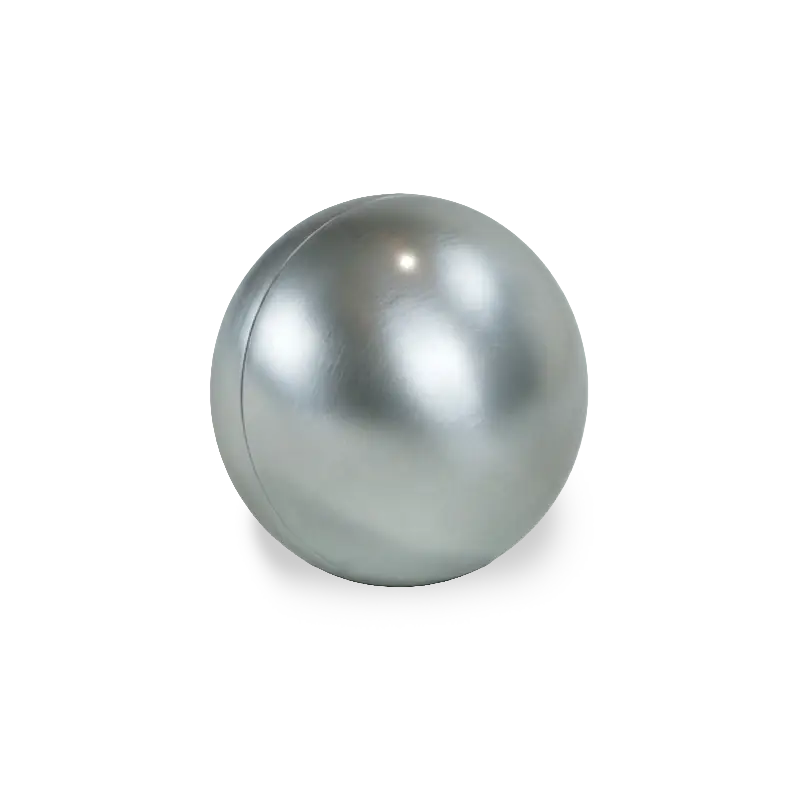
Which ball to use
The ball size sets the thickness range. Small balls for thin walls; magnetic balls, which hold more firmly, for thick walls:
| Ball | Diameter | Thickness it measures |
|---|---|---|
| Steel | 1/16" (1.59 mm) | 0 – 2.5 mm |
| Steel | 1/8" (3.18 mm) | 0 – 5 mm |
| Steel | 3/16" (4.76 mm) | 0 – 7 mm |
| Steel | 1/4" (6.35 mm) | 1 – 8 mm |
| Magnetic | 3/16" (4.76 mm) | 2 – 16 mm |
| Magnetic | 1/4" (6.35 mm) | 4 – 22 mm |
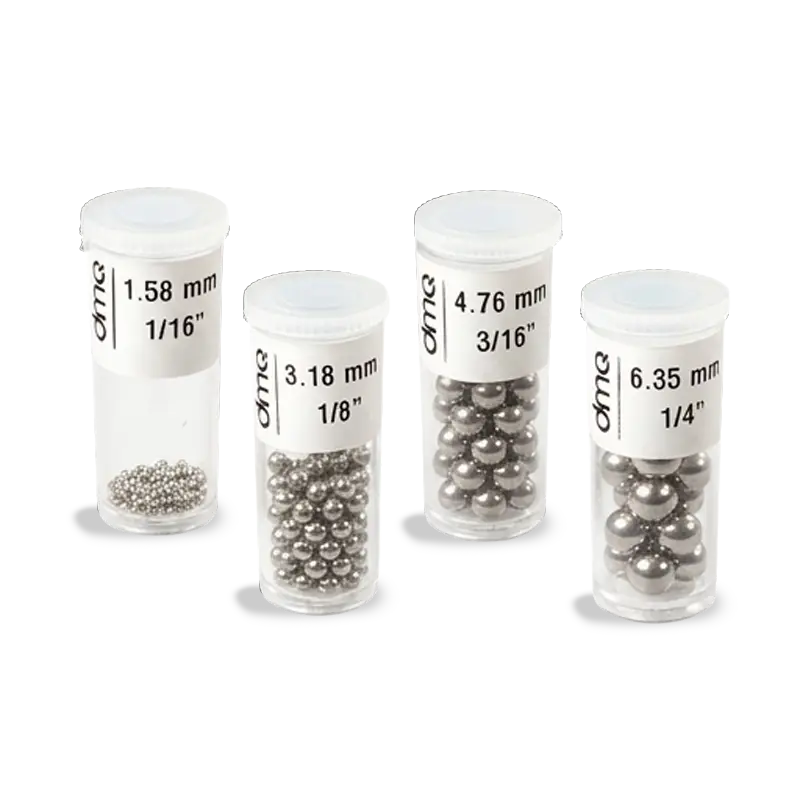
How to choose the ball in each case —narrow openings, thick walls, rubber— is explained in the guide which ball to use.
What the Hall effect needs
Being able to place the ball on the other side of the wall: it measures hollow or open parts, not solid or fully closed ones. And the material must be non-ferrous, because a steel part would attract the ball by itself. For steel, or when there is access from one side only, the method is ultrasound with the QS line; the guide Hall effect or ultrasound helps you decide case by case.
| Problem | Hall effect | Ultrasound |
|---|---|---|
| Very thin walls | From 0 mm | Difficult |
| Necks, radii and corners | Yes | Difficult |
| Measuring with no gel | Yes | No |
| No setting per material | Yes | No |
| Rubber, foams, composites | Yes | Loses the signal |
| Access from one side only | No | Yes |
Source: DEMEQ, QB7 series page and brochure (ranges by ball, resolution, functions, data outputs and power).