

Short answer
- The ball must cover the thickness you are going to measure: each size has its range.
- Among those that cover it, use the most comfortable one.
- Small balls for difficult parts and narrow openings: necks, grooves, corners.
- Magnetic balls when the wall is thick, so the ball doesn't fall off.
- Special spheres for rubber, with the QB7 R.
Each ball's range
With the Hall effect, the probe measures how far away the ball on the other side of the wall is. The thicker the wall, the further away the ball, and the larger or more magnetic it has to be for the sensor to keep detecting it well:
| Ball | Diameter | Thickness it measures |
|---|---|---|
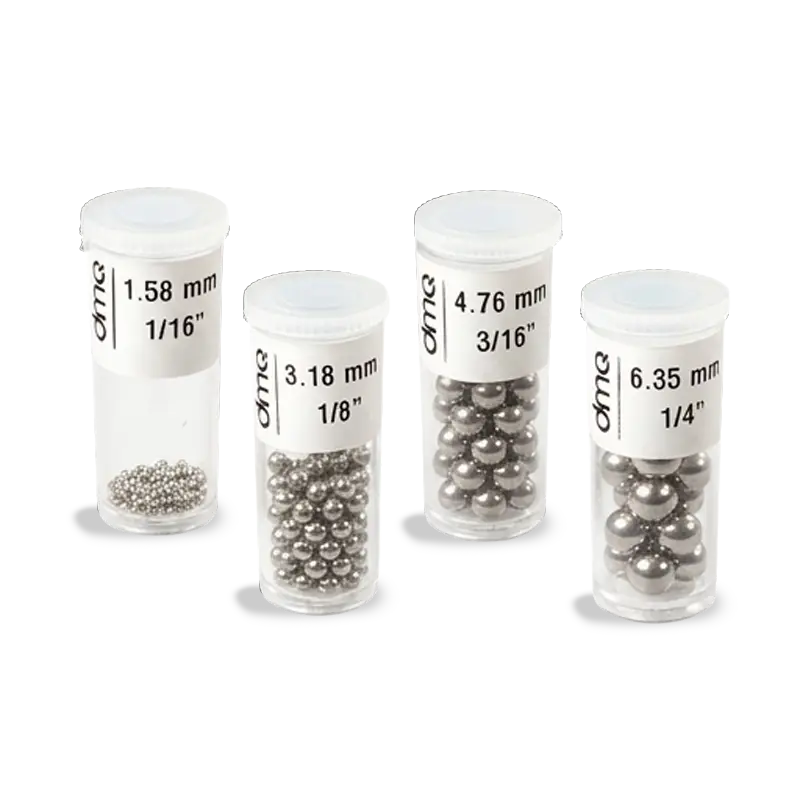
| Steel | 1/16" (1.59 mm) | 0 – 2.5 mm |
| Steel | 1/8" (3.18 mm) | 0 – 5 mm |
| Steel | 3/16" (4.76 mm) | 0 – 7 mm |
| Steel | 1/4" (6.35 mm) | 1 – 8 mm |
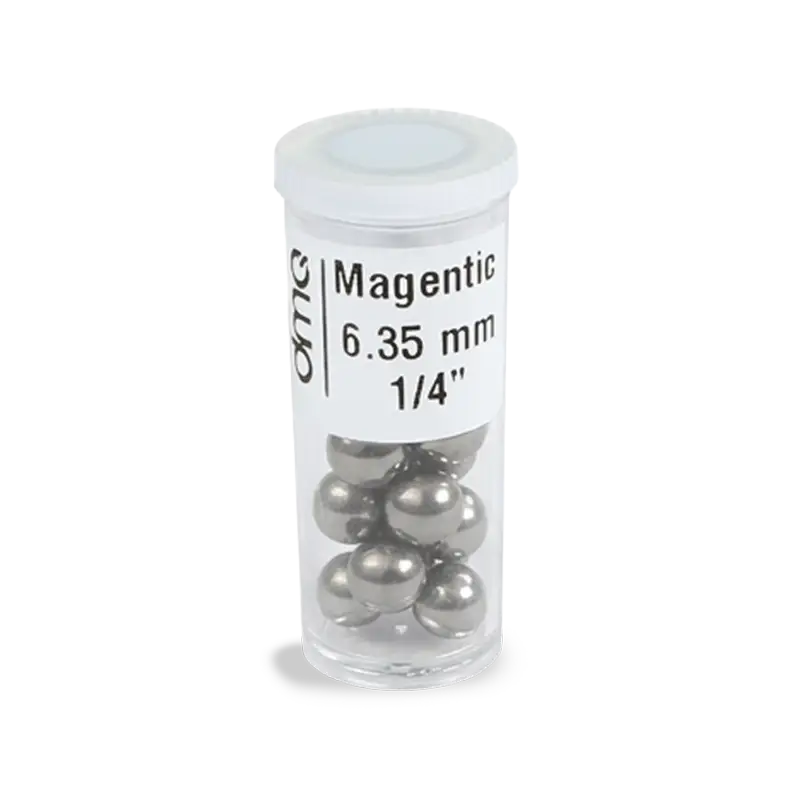
| Magnetic | 3/16" (4.76 mm) | 2 – 16 mm |
| Magnetic | 1/4" (6.35 mm) | 4 – 22 mm |
Steel balls cover up to 8 mm, the QB7 B range. Magnetic balls reach 22 mm and are used with the extended-range QB7 E and QB7 R.
Problem 1: no reading, or out of range
The symptom: the gauge gives no reading, or an unstable one, on a wall it should measure without trouble.
Why it happens: the ball is too small for that thickness: at that distance, the field the sensor detects is too weak.
How it is solved: by switching to a ball whose range covers the thickness with some margin, so the wall isn't at the limit of the range.
Problem 2: the ball can't reach the point to measure
The symptom: the ball doesn't fit through the neck of a bottle or vial, doesn't go into a groove or stays away from an inside corner.
How it is solved: with a smaller ball. The 1/16" passes through almost any opening and reaches tight corners; the 1/8" is a good compromise when the wall goes up to 5 mm. Remember that a small ball has a smaller range: check that it covers the thickness.
If the problem is on the probe side —a groove or an irregular outer shape—, the QB7's narrow titanium tip helps you reach it.
Problem 3: the ball falls off or comes away from the wall
The symptom: on thick walls, when sliding the probe or turning the part, the ball comes loose and the reading is lost.
Why it happens: the thicker the wall, the further the ball is from the probe magnet and the weaker the force holding it.
How it is solved: with magnetic balls. Being magnets themselves, they hold on to the probe through the wall much more firmly, and follow it without falling off even when the wall is thick or the part is vertical.
Problem 4: several balls would work, which one?
If the part doesn't force your hand —no narrow opening, no thick wall—, use the one that is most comfortable to handle: one you can place and retrieve easily, and that follows the probe well as you scan the part. Production control with hundreds of parts a day is much smoother with the right ball.
Problem 5: rubber
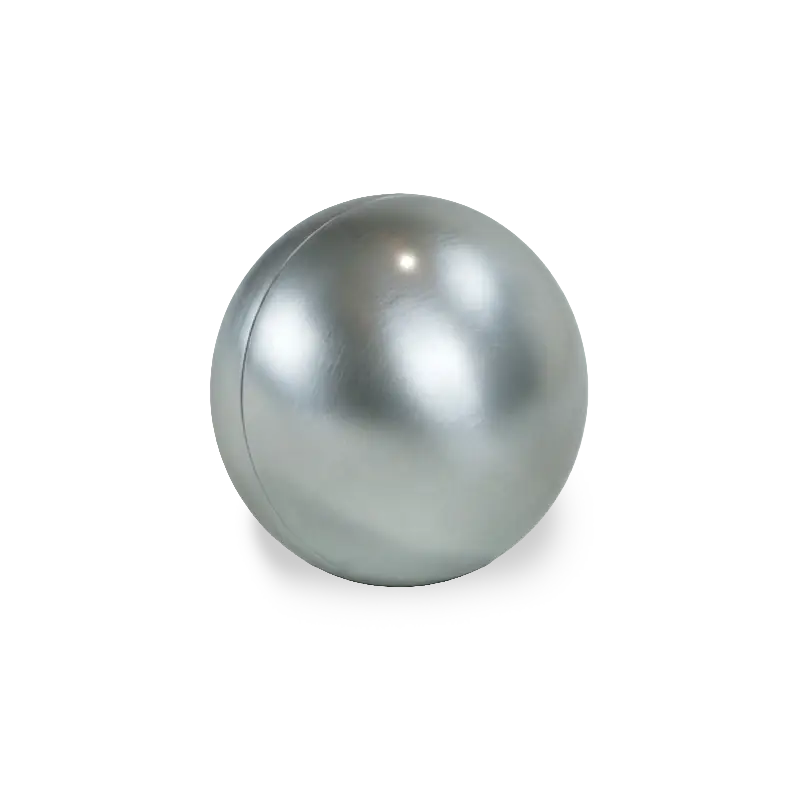
On a soft surface, a loose ball doesn't sit properly. The QB7 R uses aluminium spheres with a magnetic steel ball inside, which sit on rubber and elastomers.
Which ball to use, case by case
| Your case | Recommended ball | Version |
|---|---|---|
| Thin wall, up to 2.5 mm, through a very narrow opening | Steel 1/16" | QB7 B, E or R |
| Wall up to 5 mm in necks, grooves or corners | Steel 1/8" | QB7 B, E or R |
| Wall up to 7–8 mm, accessible part | Steel 3/16" or 1/4", whichever is more comfortable | QB7 B, E or R |
| Wall from 8 to 16 mm | Magnetic 3/16" | QB7 E or R |
| Wall from 16 to 22 mm | Magnetic 1/4" | QB7 E or R |
| Rubber or elastomers | Aluminium sphere with a magnetic ball | QB7 R |
Before measuring: the gauge must be calibrated for the ball you will use. QB7 calibration kits include the balls, zero calibrators and thickness standards; when you change ball, calibrate again.
Source: DEMEQ, QB7 series brochure (ranges by ball) and VQNDT usage criteria.