

Short answer
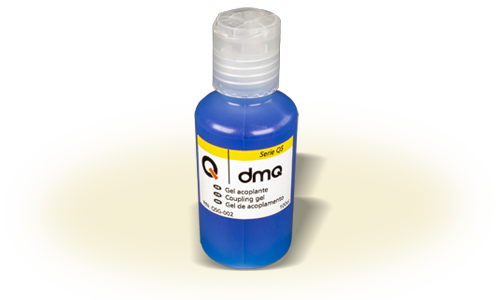
- Couplant gel is essential in ultrasound: without it, the layer of air between the transducer and the part blocks the sound.
- Use enough for a stable reading, and no more: excess gel adds to the measured thickness.
- Calibrate and measure under the same conditions: same amount of couplant and same pressure.
Why it is needed
Ultrasound barely passes from air into a solid: almost all of it bounces off the surface. A film of gel, oil or water replaces that air and lets the pulse into the part and the echo back. That is why, without couplant, the gauge gives no reading or an unstable one.

Problem 1: too little couplant
The symptom: the reading jumps, disappears or the gauge shows the transducer isn't coupled.
How it is solved: by adding gel until the reading is stable. On QS gauges, the coupling icon and the echo energy bar show it: a low bar is usually a lack of couplant. Before thinking of corrosion or a material problem, check the coupling.
Problem 2: too much couplant
The symptom: the reading is stable, but slightly higher than the real value.
Why it happens: a thick layer of gel separates the transducer from the part, and that gap adds to the measured thickness.
How it is solved: with just the right amount and firm transducer pressure, which squeezes out the excess.
Problem 3: calibrating and measuring under different conditions
The symptom: the gauge reads correctly on the reference block, but the readings on the part don't add up.
How it is solved: by calibrating and measuring with the same minimal amount of couplant and the same pressure on the transducer. If they change, the gel layer changes, and so does the reading.
Difficult surfaces
- Rough or corroded: remove loose rust and scale; gel fills the gaps, but can't couple on a crust that moves. See the corroded pipes guide.
- Painted: in echo-echo, use enough couplant for stable coupling; the second echo is weak and shows it straight away (see measuring without removing paint).
- Hot: as well as a high-temperature transducer, use a couplant rated for that temperature, and measure with brief contacts.
- Vertical or overhead: a thick gel stays in place better than oil or water.
When gel is a problem
If the part must not get wet or marked —food, cosmetic or pharmaceutical containers— or the material is very thin or complex in shape, the alternative is measuring with no couplant, by Hall effect. See the guide wall thickness of bottles, containers and plastics.
Source: DEMEQ, QS5 user manual (use of couplant, coupling indicator and energy bar).